

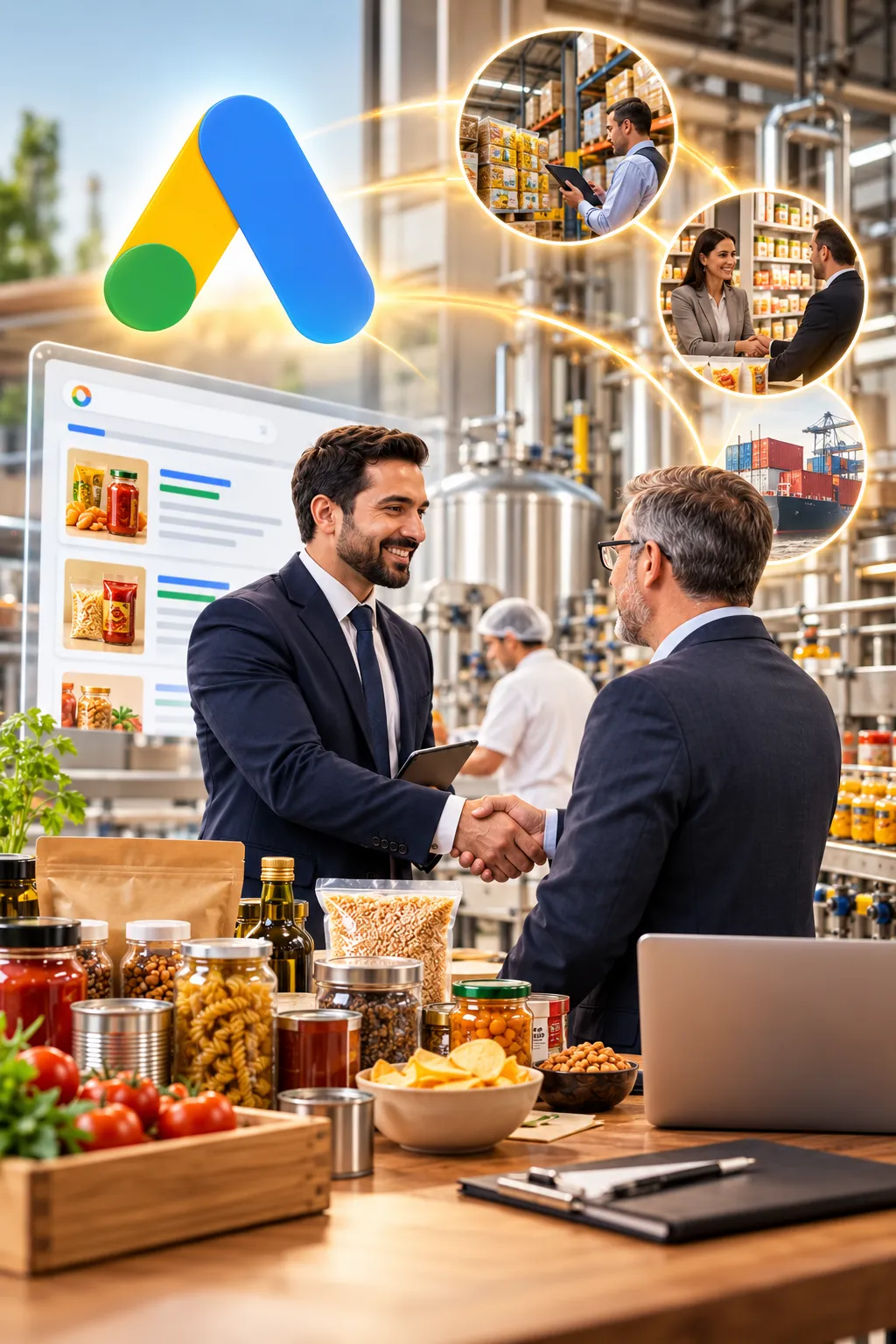
Food is the most consumer-heavy vocabulary on Google, and a B2B budget can vanish into recipe and where-to-buy searches overnight. This is paid search built to reach distributors, category buyers and private-label programs — gated by your certifications, measured in trade enquiries, not clicks.
What Google Ads does for a food manufacturer.
Google Ads management for food manufacturing means putting your capability in front of the trade buyers who place volume orders — wholesalers, distributors, supermarket category buyers, private-label programs and food importers — at the moment they search.
Start with what you are actually buying, because it is easy to get wrong. You are not buying a sale, and you are certainly not buying a shelf. You are buying a buyer meeting. A food manufacturer wins by getting in front of a category buyer or private-label program, having a first conversation, and then working through samples, audits and listing. Paid search lands that first meeting — and the whole account should be judged on how many real buyer enquiries it produces.
Then there is the certification gate. A retail or private-label buyer filters on food-safety schemes — BRCGS, SQF, FSSC 22000, HACCP — plus organic, halal, kosher and allergen control, before capability or price is even discussed. So the searches that convert are certification plus category: "BRCGS certified snack manufacturer", "organic co-packer", "allergen-free bakery supplier". Build around those and the enquiries arrive already qualified.
And then the hard part. Food is the most consumer-heavy vocabulary on the internet — recipes, where to buy, nutrition, "near me". Without brutal negative-keyword work, a B2B food budget disappears into hungry shoppers who will never order a pallet. In food manufacturing, exclusion isn't a finishing touch — it is the core of the build.
What a managed program includes
- Full PPC audit of account & wasted spend
- Certification + category keyword targeting
- Brutal consumer negative-keyword exclusion
- Search, display & remarketing campaigns
- Ad copy written for buyers, not shoppers
- Trade landing pages (certs, capacity, private label)
- Conversion tracking to buyer enquiry, not clicks
- Bing / Microsoft Advertising where it earns its place
- Reporting on qualified buyer pipeline, not impressions
Measured in buyer enquiries, not clicks and impressions.
A dashboard full of cheap food clicks is trivially easy to produce and completely worthless. What counts is how many distributor, retail and private-label enquiries reached you, and what each one cost.
Food B2B expertise
I understand the trade side — distributors, category buyers, private label, food-safety schemes and export listing — so campaigns target the buyer, not the shopper.
Consumer-exclusion discipline
The single most important skill in food PPC: shutting out the recipe, nutrition and where-to-buy traffic that drains a B2B budget.
AI-powered bidding
Smart bidding tuned to qualified buyer enquiries, not raw clicks — with human oversight so the algorithm chases trade, not consumers.
Senior-level account management
Dedicated PPC manager
You work with the person running the account, not a junior. No handover between strategy and the build.
Transparent reporting
Your own account, your own data, every month. Spend, buyer enquiries, cost per qualified enquiry — no black box.
Every food PPC service — under one strategy.
Start with the audit, or run several together as a managed program. Each exists to move one number: qualified buyer enquiries received.
Google Ads Management
End-to-end account strategy, build and optimization aimed at trade buyer enquiries. Benefit: one owner accountable for qualified buyers.
Manage my account
PPC Campaign Management
Ongoing structure, testing and budget shifts toward what converts. Benefit: spend follows buyer enquiries, not clicks.
Run my campaigns
Paid Search Advertising
Search ads on certification and category intent, with heavy consumer exclusion. Benefit: your budget reaches buyers, not shoppers.
Target buyers
Display Advertising
Visual campaigns on trade and industry placements to build buyer awareness. Benefit: you stay in mind through a listing cycle.
Build awareness
Remarketing Campaigns
Stay in front of category buyers and private-label teams who already visited, across weeks of decision-making. Benefit: you survive the slow listing sale.
Re-engage buyers
Retargeting Ads
Bring back trade visitors who viewed a capability or private-label page but didn't enquire. Benefit: fewer high-intent visits wasted.
Recover intent
Landing Page Optimization
Pages built around certifications, capacity, private label and a clear trade-enquiry path — not a consumer homepage. Benefit: the buyer knows they're in the right place.
Convert the buyer
Ad Copywriting
Copy that speaks to buyers in trade language — certifications, capacity, MOQ, private label — and reads as B2B, not retail. Benefit: the right searcher clicks.
Write my ads
PPC Audit
A full review of account structure, negatives, tracking and wasted spend, focused on consumer leakage and missed certification intent. Benefit: you see the money you're losing.
Get my free audit
CPC Optimization
Budget moved toward searches that produce buyer enquiries and away from ones that only produce clicks. Benefit: the most qualified click, not the cheapest.
Optimize my spend
Conversion Tracking Setup
Proper tracking from click to trade enquiry, sample request and private-label brief. Benefit: you optimize toward buyers, not guesses.
Set up tracking
Bing Ads Management
Microsoft Advertising reaches procurement and category buyers on corporate machines, often cheaper. Benefit: a professional audience Google misses.
Add Microsoft Ads
Enterprise PPC Management
Multi-category, multi-market accounts across search, display, remarketing and Microsoft. Benefit: scale without losing precision.
Scale my PPC
International PPC
Country and language targeting to reach food importers the moment they search country, product and certification. Benefit: export listings without the expo bill.
Go international
PPC Consulting
For teams running ads in-house — strategy, account review and training. Benefit: your team stops paying for hungry shoppers.
Book a consult
How the work runs — discovery through continuous optimization.
- PPC discovery — Your categories, certifications, private-label capability, target channels, markets, and what a genuinely qualified buyer enquiry looks like.
- Competitor analysis — Who is bidding on your trade terms, what they claim, and where the gaps are.
- Keyword research — Certification plus category, format and private-label intent — plus the vast consumer negative list that protects the budget.
- Campaign strategy — Structure, budgets and targets built around qualified buyer enquiries, not click volume.
- Search campaign setup — Tightly-themed ad groups on trade intent, with aggressive consumer exclusion from day one.
- Display campaign setup — Awareness on trade and industry placements, kept clear of consumer inventory.
- Ad copy creation — Copy that pulls the trade buyer and repels the shopper — certifications, capacity, private label.
- Landing page optimization — A page per campaign built around the certification, category and trade-enquiry path.
- Conversion tracking setup — Click-to-enquiry tracking so optimization targets buyers, not guesses.
- Bid optimization — Budget continually shifted toward the searches producing qualified buyer enquiries.
- Performance monitoring — Search-term review, negative expansion and quality checks every week — the consumer list never stops growing.
- Monthly reporting — A plain-language report and a call: spend, buyer enquiries, cost per qualified enquiry, what changes next.
What your business actually gains.
More qualified B2B leads
Distributors and buyers with real volume, not hungry shoppers.
Higher conversion rates
Right buyer, right trade page, clear enquiry path.
Better ROAS
Budget on searches that build buyer pipeline, read over the real cycle.
Immediate visibility
On trade searches while your organic rankings build.
Distributor & retailer enquiries
In front of the buyer sourcing a supplier, at the moment of search.
Lower cost per lead
By cutting the consumer spend most food accounts leak.
Export opportunities
Food importers reached in their own market and language.
More RFQs
Trade enquiries the whole account is built to move.
Better campaign performance
Continuous testing and relentless consumer exclusion.
Higher ROI
One listing from one enquiry can pay for years of spend.
Built for every kind of food manufacturer.
A snack maker and an ingredient supplier chase different buyers. The campaign adapts to your category and your channel.
Food processing companies
Primary and secondary food processors.
Packaged food makers
Shelf-stable and packaged food producers.
Snack food makers
Savoury and sweet snack manufacturers.
Frozen food makers
Frozen ready-meals, produce and proteins.
Beverage manufacturers
Soft drinks, juices and functional beverages.
Dairy product makers
Milk, cheese, yoghurt and dairy processors.
Bakery manufacturers
Bread, biscuit and bakery producers.
Organic food makers
Certified organic and natural food producers.
Private label makers
Contract and own-label manufacturers.
Ingredient suppliers
Food ingredient and additive suppliers.
Food exporters
Manufacturers chasing export listings.
Co-packers
Contract packing and co-manufacturing services.
Why paid search decides who gets the buyer meeting.
You're buying a meeting
Not a shelf. PPC lands the first conversation with a category buyer or private-label program; samples, audits and listing follow.
Certification is the gate
BRCGS, SQF, FSSC 22000 and allergen control decide who a buyer will even talk to. The highest-intent searches lead with the scheme.
Exclusion is the skill
Food is consumer vocabulary by default. Half the budget is protected by the searches you shut out, not the ones you bid on.
Private label is a program
Own-label capability is often a manufacturer's biggest opportunity and its most invisible one. Search makes it findable.
Measure pipeline, not clicks
An enquiry now can become a listing later. Tracked as buyer pipeline, PPC earns its place; tracked as clicks, it misleads.
Global reach
Food importers search country, product and certification. Paid search reaches them in-market, cheaper and faster than an expo.
Without vs. with professional management.
| Area | Without professional management | With professional management |
|---|---|---|
| Goal | Click volume | Qualified buyer enquiries |
| Who clicks | Hungry consumers | Distributors & category buyers |
| Negatives | Few or none | Vast, always growing consumer list |
| Ad angle | Product & taste | Certification, capacity, private label |
| Landing page | Consumer homepage | Trade page, clear enquiry path |
| Tracking | Clicks only | Click-to-enquiry |
| Reporting | Impressions & clicks | Cost per qualified buyer enquiry |
Questions food manufacturers ask most.
What is Google Ads management for food manufacturing?
It is running paid search and display campaigns that put a food manufacturer in front of the trade buyers who place volume orders — wholesalers, distributors, supermarket category buyers, private-label programs and food importers. It covers campaign strategy, certification-led keywords, ad copy, landing pages, conversion tracking and relentless negative-keyword work. The goal is buyer enquiries, not consumer clicks.
Why do food manufacturers need Google Ads?
Because a distributor or retail buyer sourcing a new supplier or a private-label partner starts on Google, filtering by capability and certification before they ever make contact. Paid search puts you on those exact trade searches immediately, while your organic rankings build. The catch is that food terms are consumer by default, so getting it right is entirely about reaching the buyer and not the shopper.
What am I actually buying with food manufacturing PPC — a sale?
No, and it helps to be clear about that. You are buying a buyer meeting, not a shelf. A food manufacturer wins by getting in front of a category buyer, distributor or private-label program, having the first conversation, and then working through samples, audits and listing. PPC lands that first meeting. Measured in qualified buyer enquiries it works well; measured in clicks or, worse, consumer visits, it looks busy and delivers nothing.
Can Google Ads generate wholesale and distributor leads?
Yes, and they are the enquiries worth having. A distributor or wholesaler searching for a supplier in your category has real volume behind the enquiry and a genuine intent to list. The searches are specific — a product category, a format, a certification, a private-label capability — so a well-built campaign reaches exactly those buyers and filters out the retail shopper who will never place a trade order.
What is the single biggest way a food PPC budget gets wasted?
Consumer traffic. Food is the most consumer-heavy vocabulary there is — recipes, where to buy, nutrition, calorie counts, "near me". Without brutal negative-keyword work, a B2B food campaign will burn its entire budget on hungry people who will never buy a pallet. In food manufacturing, exclusion is not a tidy-up at the end; it is the core of the whole build, more so than almost any other industry.
How does certification change the way buyers search?
Certification is the gate. A retail or private-label buyer filters on food-safety and scheme certification — BRCGS, SQF, FSSC 22000, HACCP — plus things like organic, halal, kosher and allergen control, before capability or price even enter the conversation. So the highest-intent searches combine a certification with a category: "BRCGS certified snack manufacturer", "organic co-packer", "allergen-free bakery supplier". A campaign built around those reaches buyers who are already qualified.
How long does it take to see results?
Enquiries can start within days of launch, but a real read on quality takes 60 to 90 days as the campaign learns which searches produce trade buyers versus consumers. Because food listing decisions run through samples, audits and buyer cycles, the enquiry generated now may become a listing a few months later — so the honest measure is qualified buyer pipeline, tracked over time.
How much does PPC management cost?
Two parts: the ad budget you set, paid to Google, and the management fee for building and running the campaigns. Both depend on your categories, markets and competition. Everything starts with a free PPC audit and a fixed scope, then a monthly fee. The written quote follows the audit.
What is a PPC audit?
A review of your existing Google Ads account, or a plan for a new one, covering structure, keywords, negatives, ad copy, landing pages, tracking and wasted spend. For food it looks hardest at whether consumer traffic is being excluded and whether certification and private-label intent is being captured — the two places food budgets usually leak or miss.
How does CPC optimization work?
By moving budget toward the searches that produce buyer enquiries and away from the ones that only produce clicks. On trade food searches the aim is not the cheapest click but the most qualified one — a distributor or private-label buyer is worth paying more to reach, while a cheap consumer click is worth nothing to a manufacturer selling by the pallet.
What is remarketing, and does it work for food B2B?
Remarketing shows ads to people who already visited your site. It works in food B2B because listing decisions are slow and involve several people — a category buyer who viewed your private-label page can be kept in mind while procurement and quality teams get involved. It keeps you visible through a long decision without paying for a fresh click each time. The key is remarketing only to genuine trade visitors, not the consumers a good campaign has already worked to exclude.
What is conversion tracking, and why does it matter here?
It connects an ad click to what happened next — a trade enquiry, a sample request, a private-label brief, a spec-sheet download. Without it you cannot tell a distributor enquiry from a consumer bounce, and you end up optimising toward the wrong traffic. In food, where consumer clicks are everywhere, tracking is what lets the campaign learn which searches bring real buyers and shift budget toward them.
Can Google Ads target international food buyers?
Yes, and it is one of the strongest uses of paid search for food exporters. Importers search by country, product and certification — and you can put your capability in front of them, in their language, at that moment. For a manufacturer chasing export listings, that reaches sourcing buyers far more cheaply than a food expo, and it reaches them while they are actively looking.
Why is landing page optimization important?
Because a trade buyer landing on a consumer-style homepage full of recipes and pack shots assumes you sell to shoppers, not to them, and leaves. A page built around your certifications, capacity, private-label capability and a clear trade-enquiry path tells a buyer they are in the right place. Given how valuable each listing is, the landing page is often where the campaign is won or lost.
Do you manage Bing Ads?
Yes. Microsoft Advertising is worth running in food B2B because procurement and category-buyer staff often work on corporate machines that default to Bing. Volume is lower than Google, but the audience skews professional and the cost per click is frequently cheaper, so it commonly earns a place in the mix.
How is ROAS measured?
Return on ad spend compares revenue to money spent on ads. In food B2B it is read over a longer horizon than consumer, because an enquiry now may become a listing and repeat volume later. So it is tracked as qualified buyer pipeline first and revenue over time, rather than a single-month figure that would misrepresent a listing cycle.
Do you provide monthly reports?
Yes — a plain-language report every month covering spend, the searches that produced trade enquiries, cost per qualified buyer enquiry, and what changes next. Growth clients also get a live dashboard. The focus is always on qualified buyers reached, not consumer clicks and impressions.
Talk to me about Google Ads Management For Food Manufacturing
If you would like help applying this to your business, get in touch for a free consultation or see my PPC and Google Ads management page for how I work.

Saddam Adil
Senior Digital Marketing Executive with 7 years in SEO, Google Ads, Meta Ads and AI automation. Currently at Crest Speciality Resins in Ahmedabad and relocating to Germany. Studio projects run under Black Monk Studio.